12% Dividend Yield Investing In The S&P 500

There are a lot of exchange-traded funds (ETFs) with really high dividend yields.
But you need to be incredibly careful.
Some of these funds are doing some crazy stuff.
And you can get burned if you don’t understand what these funds are doing.
One fund in particular is gaining in popularity, so I wanted to talk about it.
NEOS S&P 500 High Income ETF (ticker: SPYI) only started in 2022.
But as of last week, SPYI is holding about $8 billion in assets in its fund.
Why is it so popular?
SPYI pays dividends every month and currently has a dividend yield over 12%.
How does SPYI do it?
SPYI invests in stocks in the popular S&P 500 index.
Generally speaking, the S&P 500 consists of the 500 largest stocks in the United States.
So you’re getting some really big companies.
But the S&P 500 index only has a dividend yield just north of 1%.
SPYI uses call options on the S&P 500 index to generate income.
Here’s how it works.
SPYI sells call options on the index to collect premiums.
When SPYI sells a call option, it’s required to sell the index at a certain price (the strike price) at a future date.
Essentially, SPYI takes on the risk, and collects a premium to do so.
SPYI then takes those premiums and gives them out to investors as a dividend.
Remember about index options because it’s important in a minute.
ETFs like SPYI are becoming more and more popular, so it’s really important to know what you’re getting.
You’re taking on the risk, and in return you’re getting dividend income.
Relative to the overall market, ETFs like SPYI will perform worse when the market rises.
Below is a chart comparing SPYI to the S&P 500 index since inception with dividends reinvested.
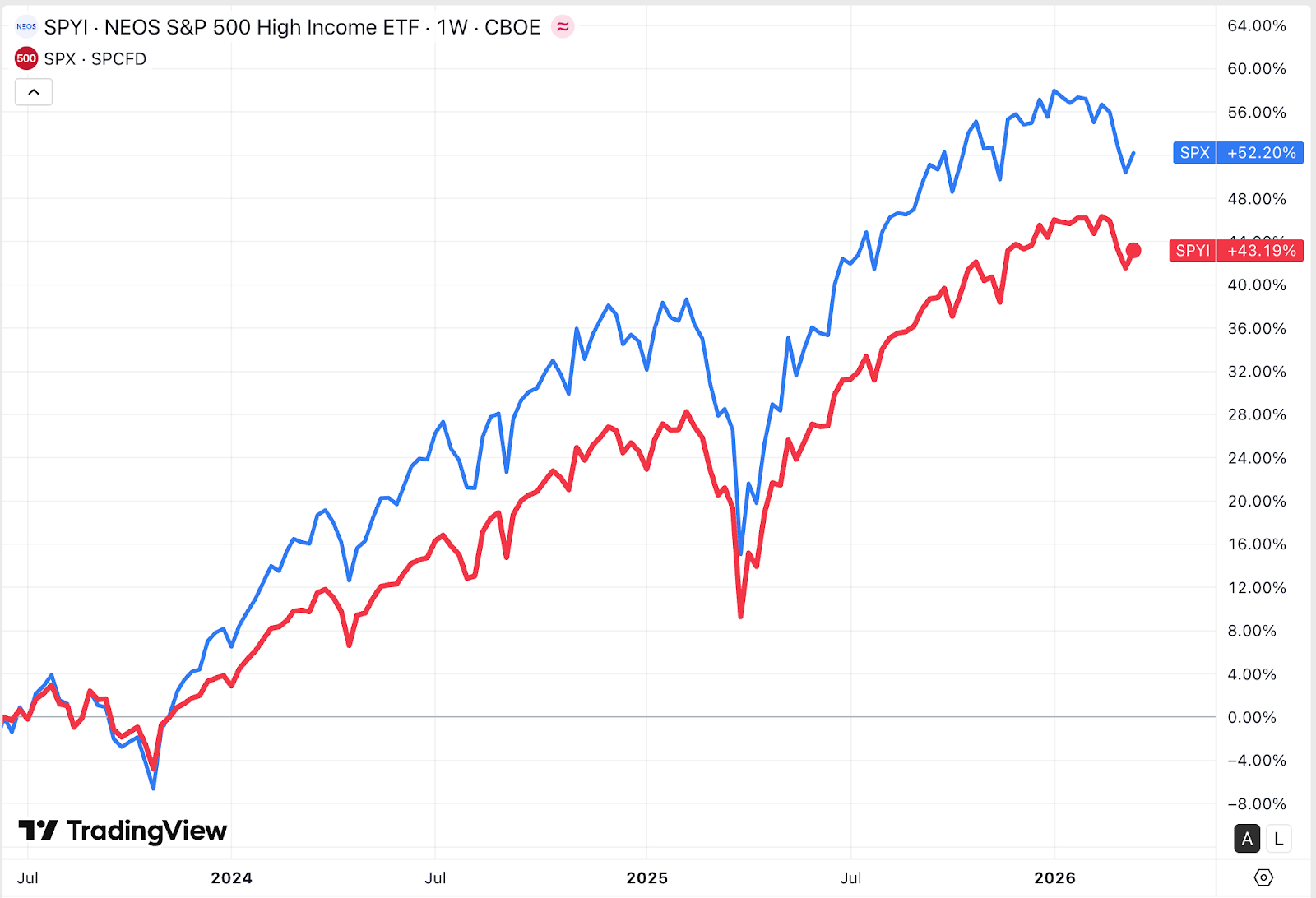
When the S&P 500 is stable or falling, like in 2022 and most of 2023, SPYI tracks pretty closely.
However, once the S&P 500 starts rising quickly, like in 2024, SPYI can’t keep up.
It’s because the price rises higher than the call option strike price, so SPYI doesn’t rise as much.
I want to really stress the point.
If the market rises quickly, SPYI will underperform.
And since it’s the stock market, we should expect periods of rapidly rising prices.
However, it doesn’t mean SPYI is a bad ETF.
Compared to some of its competitors, SPYI is doing awesome.
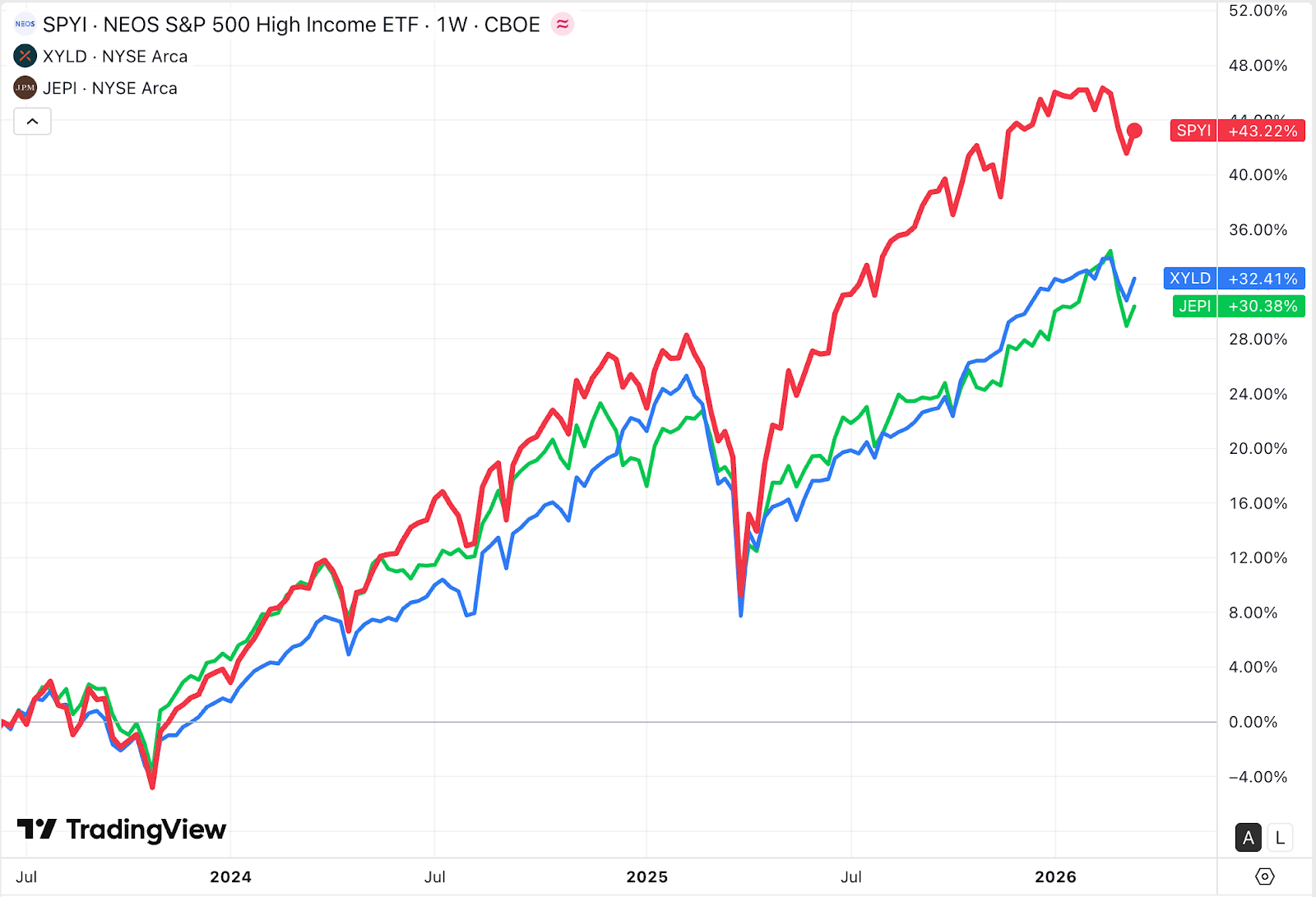
One other major benefit of SPYI over its competitors is taxes.
SPYI sells index options while the others sell options on individual stocks in the index.
Why does it matter?
SPYI’s dividends are taxed as return on capital, which lowers your cost basis.
So you don’t owe any taxes on SPYI’s dividends until you sell.
And when you do, and assuming you held SPYI longer than a year, you’re only paying long-term capital gains tax.
JEPI’s and XYLD’s dividends are taxed at ordinary rates, which are higher than long-term capital gains.
You can see why SPYI is so popular.
We’re sacrificing some gains to get a higher dividend yield.
But if you need the income, then SPYI and its 12% dividend yield is well worth it.
Do you own any of these covered call ETFs?
Michael Jennings, Editor
Dividend Stocks Research
Category: Dividend Yield